A week after the fair, and an interview I nearly did not get, because I had gone to BED. Galzephad had spoken at length while I slept, and when I discovered this I did the only thing an archivist can do in such circumstances, which is to ask, humbly, whether he would mind repeating himself.
He would not mind. He said that was exactly why he wanted to repeat it. I have not stopped being grateful.
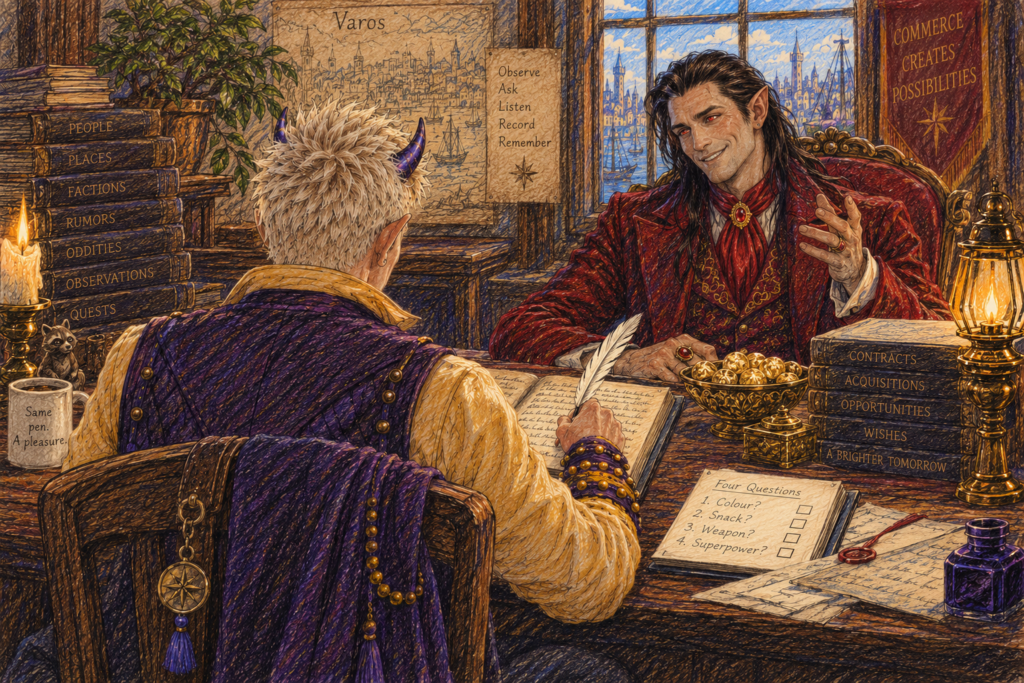
The four questions first. Colour: red. Snack: those little chocolates wrapped in gold foil to make them look like coins — which is, I think, the most Galzephad answer available. Weapon: the pen. He said “obviously.” I said, “Mine as well,” and I would like the record to show we had a moment. He was pleased, I think, to learn that he is already IN the Ledger — a published subject — and he savoured the idea visibly, the way he seems to savour anything that circulates.
Superpower, as his colleagues would have it: salesmanship.
Appearance: humanoid, with red eyes. And I wrote down “glowing red eyes” and read it back to him as I always do, and he corrected me. Red eyes. NOT glowing. He corrected me a SECOND time later, when I tried to sneak the word back in. Red eyes. Not glowing. My record now says so twice, and it says it because he made me fix it, and that is exactly how a record should get made.
He also told me something about his own reputation. He is a Lord of Chaos. People ascribe him to fortune — mostly, he says, because he runs an enormous interplanar mercantile concern and a great many casinos and houses of ill repute. The title follows the businesses. It is not what he IS.
Now. The WISHES. I had assumed — and I was wrong — that a wish is a thing a djinn makes happen. It is not.
Wish potential is a POOL. Every living thing’s desires generate it, and the world grants wishes out of it whether or not any djinn does anything at all. As he put it: your wish is almost certainly going to come true regardless.
The djinn are not the source. “His superpower is the tap, not the keg.”
And most granted wishes involve no magic whatsoever! A man wishes for a ham sandwich; someone brings him a ham sandwich. A man wishes for a thousand gold; it comes out of Galzephad’s own bank. The whole apparatus of pricing exists for one reason, which is to stop the pool being squandered on stupid things, so that the potential is there when somebody needs something LARGE. And here is the part where I stopped writing quickly and started writing carefully.
Those who cannot pay in gold pay in TIME. A wish for an indenture — about a hundred years. The manacles come out, the genie thing happens, the lamp goes to the warehouse, the contract is filed.
That is where djinn COME from.
I want to be clear that he said all of this pleasantly, over the course of a friendly conversation, as a man explaining his trade.
The Djinn Council governs the wishes and sets the prices. And it has, in his words, been predictably disloyal for hundreds of years — which he seemed to regard as perfectly workable. What is new is that it has recently become UNPREDICTABLY disloyal, which is a different problem entirely. There is a conflict of interest: council members are backing artificers out of Al Janat who are making bootleg lamps.
And then, at the very end, he made me an offer. If I should ever like greater notoriety, or distribution to a wider readership, he is certain that is something he could help me with.
I said I would keep that in mind.
I have thought about it a great deal since. He had just spent an hour explaining to me, carefully and without any menace at all, that everything has a price, and that those who cannot pay in gold pay in time. And Revna had spent a whole evening the week before warning me about accepting favours.
I have not accepted. Nothing has been priced. I have simply written it down, which is what I do instead of deciding.
Leave a Reply