In the tavern, late: Rom, Nora, myself, and Revna. And I filled more pages in that one conversation than in the rest of the weekend put together, and I am still not certain I understood the half of it.
Let me start with what is structural, because the structure turns out to matter enormously.
Oberon was King of Arcadia. And Oberon is now part of the Maze of Convolutions — not trapped in it, not lost to it. He IS it. Titania was Queen. I wrote both names down and then sat looking at the gap between the two sentences.
The Fenrae wanted to overthrow Oberon. And here is the part I had not understood before and which reorganised everything: the Fenrae were cursed AS WELL. Not as punishment. Not as a judgement on the sedition. They were simply ADJACENT to Arcadia when the curse landed, and so they are cursed. The curse spread by PROXIMITY.
That is a very different sort of horror than the one I had been carrying around. A curse that punishes is at least legible. A curse that merely reaches is not.
Then the throne, and here Revna turned teacher. Yamato asked what greater power one could have over a realm than “I created it” — and he walked us through how claims actually WORK. As far as Arcadia is concerned, “I occupy the throne” is the stronger statement. Stronger than creation. The formula outranks the founding. He gave it as a rule, with the detachment of someone explaining weather, and I have recorded it as a rule.
What I came away asking — and it is my question, not his statement — is whether Yremmel is trying to take the title King of Arcadia. Because he founded the Terran Valley by simply declaring that there is a throne and he occupies it, and no bloodline was needed for THAT. Arcadia is different. Arcadia’s claim runs by blood, and absolutely: how much do you have? I have more.
And then Revna told me about himself, and I am going to set it down flatly, without ornament, because ornament would be a kind of lie.
He was abducted. He lost everything. He was given a new name, a new life, and power — but no direction. And then he was disowned. Yremmel took his name, his identity, his humanity. And he took her SISTER.
Kianise is his sister. Revna said: “He would like you. I cannot say you would like her.” I have thought about that sentence more than any other from the whole weekend.
I also learned how Yremmel builds a following, and I am recording it because a record that flinches is not doing its job. He finds children who are hurt — beaten, hated, hungry, alone in the world — and he arrives to them like mercy, and offers a home, and siblings who care. And they do not know what they have been gathered for.
I put my pen down for a while after that one.
One more thing, and it is an object. Rom has a dagger that belongs to Revna, and it unravels whoever it stabs. Not kills — UNMAKES. The bindings of a thing come apart, body and spirit and ideas and memories all dispersing, and afterwards the memory of the unmade thing slowly fades for everyone who knew it. Its sharpness extends into the astral. Used on something living it is apparently rather like popping a pressurised balloon.
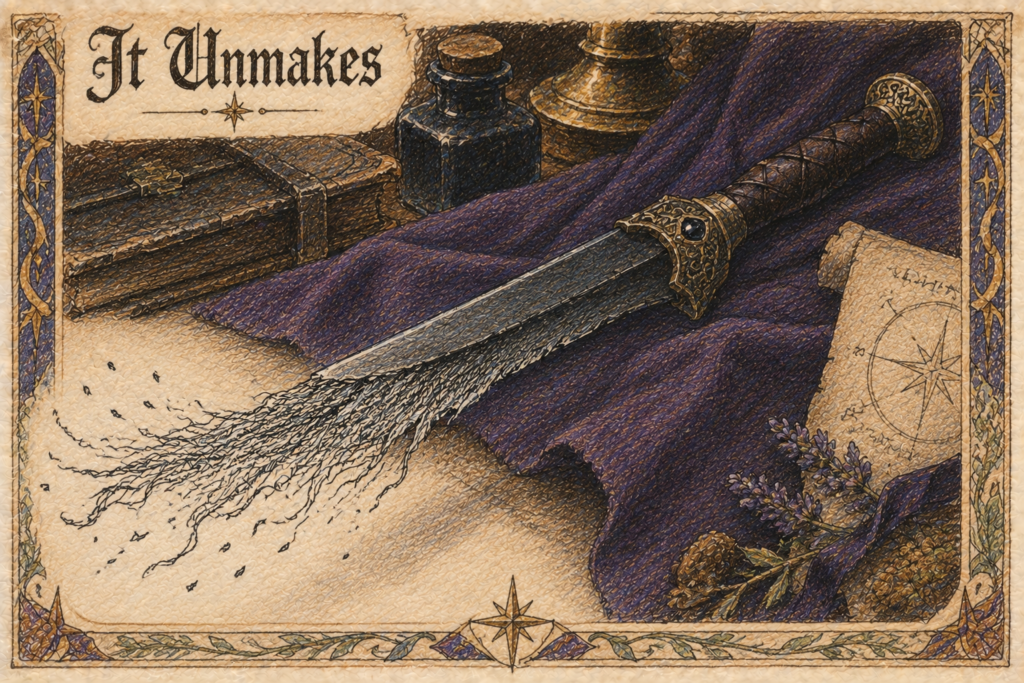
There is a safer technique, which I find more frightening than the dagger: cut away the LOCATION a thing occupies. A thing with nowhere to exist simply ceases.
I asked no follow-up. I wrote it down twice.
Leave a Reply